

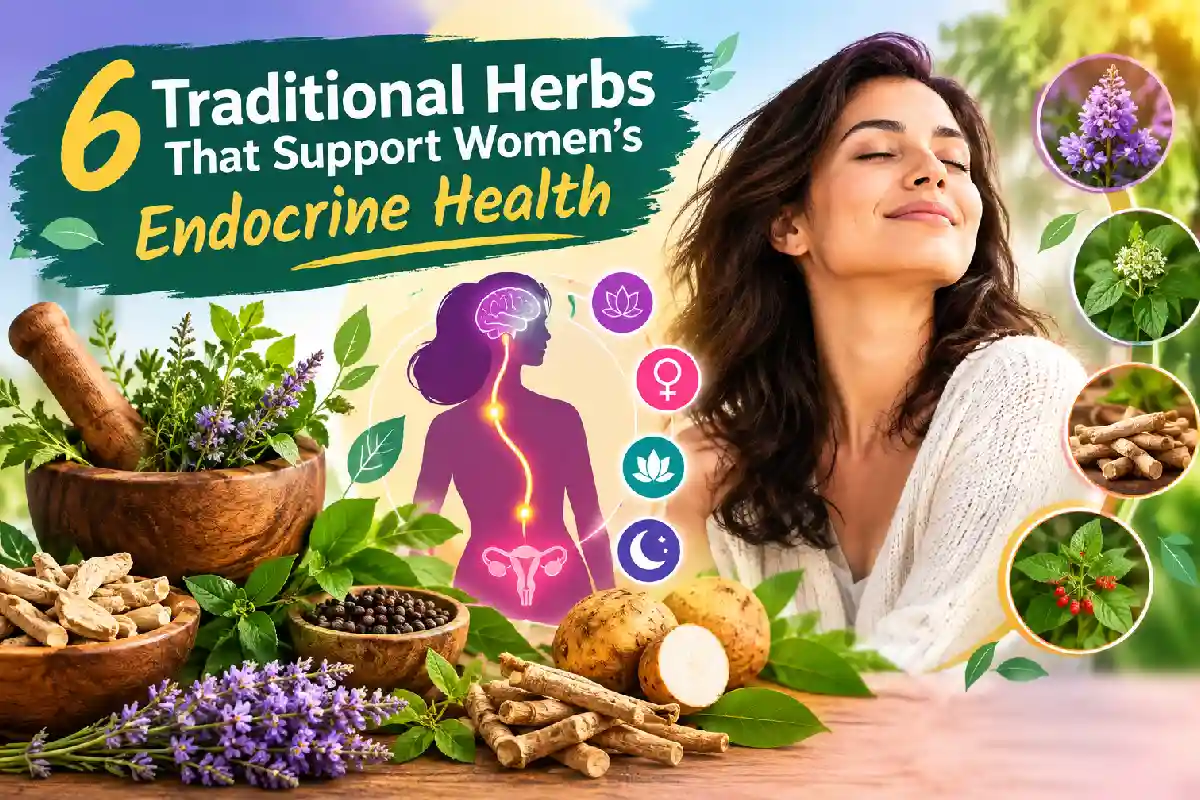
The topic of hormonal wellness tends to get sensationalized by the media. It’s important to keep in mind that hormonal wellness is a tool for metabolic balance, not a marketing category. The following botanicals have stood the test of time use and can truly support hormonal balance in the body.
Table of Contents
Stress is the hormone problem nobody names first
Before diving into specific herbs, it is important to explain why stress management is at the core of almost every hormonal issue that patients report to a healthcare provider. Your body synthesizes cortisol and progesterone from the same precursor molecule, called pregnenolone. When the hypothalamic-pituitary-adrenal (HPA) axis is overactivated, your body will favor the production of cortisol because it perceives stress as a top-priority issue. This leads to a reduced amount of pregnenolone being available for the synthesis of progesterone, a process known as “pregnenolone steal.”
You can see why so many issues that are often chalked up to a progesterone deficiency are actually a stress issue that happens to fit into a progesterone costume. A luteal phase that’s too short to conceive, PMS that’s gotten more intense over the years, sleep that tanks the week before your period – you’re likely dealing with a stressed-out HPA axis that’s been going full throttle for a while. Any herbal approach that doesn’t take this into account and goes straight to hormone-balancing herbs is getting ahead of itself.
Wild yam: correcting the myth so the actual use makes sense
Wild yam (Dioscorea villosa) is perhaps the most incorrectly marketed herb in this class of treatments, so let’s just lay it out there. Wild yam root contains diosgenin, a steroidal saponin which, if subjected to a multi-step chemical process in a laboratory, can be converted to progesterone. The key phrase is multi-step chemical process, though: There’s no way for this conversion to happen in the human body. We don’t possess the necessary enzymatic pathways to make this transformation naturally, and that’s the end of the story. Any supplement or product telling you that wild yam cream or tincture “boosts your progesterone levels” is making a claim that goes beyond the science.
That doesn’t mean wild yam is useless, however, and this is where a lot of the commentary around natural therapies ends up throwing the baby out with the bathwater. A traditional preparation of wild yam extract in a topical application has been used for centuries as a soothing treatment for breast tenderness, lower-abdominal cramps, and the joint and muscle aches that come with perimenopause. It’s a botanical anodyne, not a hormone, and in these cases is administered in a way that’s similar to the use of arnica or menthol rubs: Locally, as needed, as part of a regular self-care routine, rather than as a systemic preparation that expects to impact blood hormone concentrations. The same is true today: No one who uses a well-prepared topical option like Naturally Linda wild yam cream is going to be disappointed by the results, as long as they hold appropriate expectations.
Vitex is the most researched herb for PMS, and it works differently than you’d think
Chasteberry, or Vitex agnus-castus, is the herb with the greatest number of good quality trials for PMS. This herb doesn’t contain hormones. Instead, it acts on the pituitary, that master gland in your brain, which in turn has a “downstream” effect on other glands including your ovaries. It acts to slightly reduce the secretion of a hormone called prolactin. When prolactin is a little lower, progesterone works a little better during the luteal phase, our body’s own production of second-half-of-the-cycle progesterone becomes a little more efficient, and symptoms of estrogen dominance become a little less severe.
It’s a subtle difference. For example, much smaller than doubling your own progesterone dose with a cream, or supplying the potent progestin drospirenone in the oral contraceptive pill Yasmin. But it is a difference. You can see why a one-size fits all, dosed-like-drugs approach to PMS management might miss subtlety like this. The syndromes all look the same from a distance – bloating, irritability, mood swings, breast tenderness. It’s only on paying close attention that differences emerge.
Ashwagandha protects the pathway that makes progesterone possible
If vitex has the reproductive side of the equation covered, ashwagandha has the stress side, so the two tend to play well together. Ashwagandha is a member of a class of plant compounds known as adaptogens; rather than specifically sedating or stimulating the HPA axis, they’re presumed to help normalize its output. Lower cortisol output can help ensure that fewer of those precious steroid precursors are getting shunted in the direction of cortisol and away from progesterone.
The evidence base here is stronger than it is for a lot of adaptogens, with at least one solid dose-ranging RCT indicating that in particular, a 600 mg/day dose of root extract can measurably alter cortisol output. A 60-day double-blind randomized controlled trial of that dose published in the Indian Journal of Psychological Medicine in 2012, for instance, saw roughly a 28 percent mean drop in serum cortisol and a 44 percent drop in perceived stress scores in adults with chronic stress relative to placebo.
Maca doesn’t contain hormones – it talks to the axis that makes them
Maca root has often been advertised as a hormone booster, but it doesn’t directly raise hormone levels – in fact, estrogen, progesterone, and testosterone stay the same even as libido and mood improve. This suggests that rather than feeding in hormone building blocks, as a food would, maca is likely nourishing the master glands and helping the body itself make more desirable hormones, or better use the ones it’s taking in. And indeed, we see that when women consume maca instead of growing extra high in hormones, their bodies just make better use of the natural level.
Black cohosh and evening primrose oil for specific transition symptoms
Black cohosh is a herb known for its support during menopause, but its overall clinical evidence is mixed. Randomized trials with its standardized preparation of triterpene glycosides have suggested slightly lower frequency and severity of hot flashes with enough of them to say it’s worth a try, particularly in early menopause. Those in later postmenopausal years may not see much benefit. Enough additional trials find no difference from placebo to suggest that black cohosh won’t work for everyone, but if it doesn’t work for you, at least you’ll know. The one established contraindication here is to avoid black cohosh in women with liver conditions or a history of liver disease; rare liver toxicity cases have been reported.
Evening primrose oil doesn’t work in the same way at all; this rich source of the omega-6 fatty acid gamma-linolenic acid (GLA) adjusts the body’s levels of various prostaglandins. If you’re not into biochem, a simple way to think about it is that for some people, too many prostaglandins can equal too many aches, pains, and inflammation in general: they do a lot of the signaling involved with inflammation and pain. When people think of using evening primrose oil in PMS, it’s generally these prostaglandin adjustments that are coming into play.
How to actually vet an herbal supplement before you buy one
The herbal supplement market is wide open to anyone who wants to enter, so what’s on the label and what’s in the bottle often don’t come close to matching. A few reality checks can help to separate a product designed to do what it promises from one that’s more of a marketing exercise.
First, look for third-party testing – a certificate from the USP, NSF, or another independent lab that indicates the product meets label claims and is free of contaminants. Then, it’s worth thinking about the source: is it organic or wildcrafted? Herb quality can differ significantly depending on where and when it’s grown and harvested. Standardized extracts that specify the percentage of the active constituent (for example, standardized triterpene glycosides in black cohosh) can give you more information than a “proprietary blend” will. Finally, a short ingredient list (with no fillers, binders, or artificial dyes) is often a good guide to a company that’s not cutting corners elsewhere, either.
None of this guarantees an herb will work for you. It just helps to eliminate the ones that were never going to.
Safety guardrails that matter more than most people realize
These are active compounds, not inert wellness props, and they deserve to be treated that way. Vitex, maca, and black cohosh should generally be avoided during pregnancy and breastfeeding unless a provider says otherwise. If you’re on hormonal birth control, hormone replacement therapy, or thyroid medication, check with whoever prescribed it before adding vitex, black cohosh, or maca, since interactions with hormonal signaling pathways are plausible even where research is thin.
And there’s a line where herbs stop being the right tool. Cycles that stop entirely, bleeding that’s dramatically heavier or more painful than your baseline, or symptoms that are getting worse despite consistent lifestyle and herbal support are signals to see an endocrinologist or OB-GYN rather than trying a different supplement. Herbs are good at supporting a system that’s basically functional under stress. They’re not a substitute for diagnosing a system that isn’t.
Traditional herbs earned their reputation over generations of actual use, and modern research has validated more of that use than skeptics like to admit. The honest version of this story isn’t hype or dismissal. It’s knowing which herb does what, matching it to the symptom it’s actually built for, and giving your body’s own hormonal machinery the support it needs to do the rest.