

Table of Contents
Summary
The most prevalent way healthcare workers are exposed to bloodborne pathogens (BBP‘s) is through needlestick or sharps injuries, which make up 80-83% of all occupational BBP exposures in the clinical setting. The three predominately transmitted BBP‘s via needlestick or sharps injuries are Hepatitis B virus (HBV), Hepatitis C virus (HCV), and Human Immuno deficiency virus (HIV). This guide reviews all types of exposures, transmission risk for each pathogen, who is most at risk, OSHA‘s legal responsibilities, and whether the prevention methods are effective.
Each shift, hundreds of thousands of healthcare workers in the United States arepracticing on a daily basis with needles, scalpels, IV lines and other sharps in a presence of blood and body fluids that is a constant occupational hazard.
The question – what is the most common risk of exposure to bloodborne pathogens for healthcare workers? – can be answered clearly with, needlestick and sharps injuries.
Or grasping, why it is that this particular risk beats all the rest, what it means in concrete terms, which pathogens it carries, what we have got to do about it this is what this guide is about.
Defining the risk: What is a Bloodborne Pathogen Exposure?
Bloodborne pathogen exposure:when the healthcare worker has contact with blood and other potentially infectious materials (body fluids), (through contact capable of transmitting the infectious disease).
Bloodborne pathogens are microbes that are present in human blood and can lead to disease processes that are serious or even life threatening and present a significant risk of transmission to healthcare workers. The three most important bloodborne pathogens in occupational use are HIV, HBV and HCV.
There are two broad categories of exposure in healthcare settings:
Percutaneous exposure Skin puncture or breakage caused by contaminated sharp instrument. This is the most common and highest risk.
Mucocutaneous exposure or exposure of infected blood or body fluid to mucosal membrane(s): eyes, nose, mouth) or non-intact skin: (cut, rash, abrasion).
In the clinical setting, the most common cause of occupational transmission is needlestick and sharps injuries. Other sources that contribute are percutaneous injuries through skin breach by cuts or abrasions, puncture wounds, human bites, and contact with body fluids through the mucous membranes.
The Direct Answer: Needlestick and Sharps Injuries
The most frequently encountered bloodborne pathogen exposure risk for healthcare workers, is from percutaneous injuries, or needlestick and sharps injuries, which result from contact with contaminated needles, scalpels, suture needles, IV stylets, lancets, broken glass, and other sharp objects.
The most common way for exposed healthcare workers to come into contact with bloodborne pathogens is through needlesticks, accounting for 80% of contact with blood. Exposure to a small amount of blood is capable of transmitting over 20 different types of pathogens.
The magnitude of this issue in the US is real. worldwide there is an estimated 3 million occupational exposures to blood borne pathogens every year; 400,000 of which are sharps injuries occurring in US hospitals.
According to the CDC, there are an average of 385,000 sharps related injuries each year in US hospitals among healthcare workers. Sharps injuries are a large injury and health hazard to healthcare workers and cause numerous direct and indirect organizational cost.
This renders Needlestick injuries by themselves not only a clinical hazard but a major public health and occupational safety issue which the US healthcare system regulate, observe, and legislate against.
Why Needlestick Injuries Are So Dangerous: The Transmission Risk by Pathogen
Not every needlestick results in infection — but the risk is real, varies significantly by pathogen, and is never zero. Here is the transmission risk profile for each of the three primary bloodborne pathogens:
| Pathogen | Transmission Risk Per Needlestick | Primary Concern |
|---|---|---|
| Hepatitis B Virus (HBV) | 6–30% (unvaccinated) | Most efficiently transmitted; vaccine-preventable |
| Hepatitis C Virus (HCV) | ~1.8% | No vaccine available; chronic infection risk |
| HIV | ~0.3% | Lowest per-exposure risk; PEP available |
Prospective studies of healthcare workers have estimated that the average risk for HIV transmission after a percutaneous exposure is approximately 0.3%, the risk of HBV transmission is 6 to 30%, and the risk of HCV transmission is approximately 1.8%.
Hepatitis B Virus (HBV): The Highest Per-Exposure Risk
HBV is the most efficiently transmitted bloodborne pathogen in the occupational environment: under certain conditions there is up to a 30 per cent chance of transmission in a single on-the-job needlestick from an HBV-positive patient. That exceeds the risk of transmission posed by both HCV and HIV.
The most prevalent occupational infection is Hepatitis B. According to the CDC, annual worker exposure to 5, 100 Hepatitis B infections is made through occupational exposure.
The important protective factor: HBV is the sole significant occupational bloodborne pathogen to have an effective vaccine. Personnel who have received the complete HBV vaccination series and respond with sufficient levels of antibody are considered protected.
Hepatitis C Virus (HCV): No Vaccine, Chronic Risk
The risk of HCV transmission from a needlestick averages 1.8%, less than HBV, but an important distinction there is no vaccine to prevent HCV, nor is there reliable PEP to prevent HCV infection following a confirmed exposure to the virus.
HCV is even more deadly because, in about 75 85% of that is newly infected,the chronic form develops, which may eventually silently develop into cirrhosis, liver failure or liver cancer over a span of many years. If these newly infected people have been easily tested then modern drugs called the direct-acting antivirals (DAA‘s) can cure them.
HIV: Lowest Per-Exposure Risk, But Life-Altering
HIV post-exposure risk of transmission from a needlestick is 0.3%. HIV post-exposure prophylaxis (PEP) decreases risk by 79%. Deep injuries are associated with a 15-fold higher risk.
HIV has the lowest per-needlestick transmission rate out of the three, but the implications of being infected are lifelong. Importantly, post-exposure prophylaxis for HIV (a 28 day course of antiretroviral medication) is extremely effective if begun within 72 hours of the needlestick. The window of opportunity is time-sensitive, with each passing hour reducing the efficacy.
Currently the kind of occupational exposure held by the healthcare worker maybe an even higher risk than before, as there is now the added complication of co-infection with several blood borne infection and multi-drug resistant organisms, HIV, Hep B C and meta- resistant staphylococcus aureus.
All Routes of Bloodborne Pathogen Exposure: A Complete Breakdown
Though needlestick and sharps injuries are the premier route of exposure, there are other routes of exposure for healthcare workers that are equally important:
1. Needlestick and Sharps Injuries (Primary Risk)
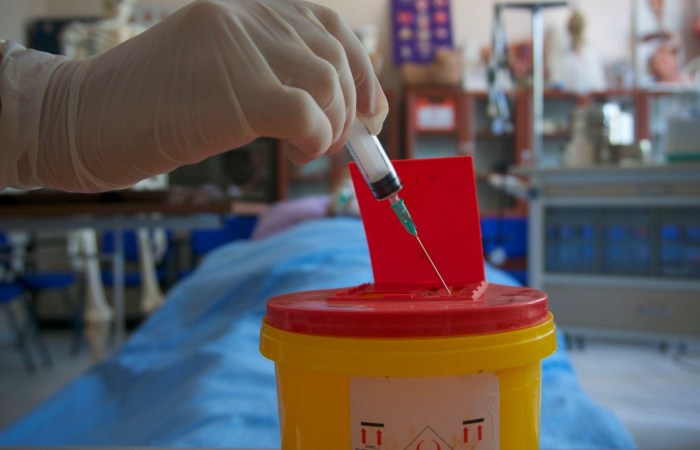
Contaminated needles, scalpels, suture needles, lancets, IV stylets, saw blades, and broken glass vials.
Most frequent route of occupational exposure to blood and other body fluids was through needlestick and sharps injuries (83.56). The highest number of incidences took place in hospital ward settings (50.07%) and operating rooms (18.52%) taking place on the fingers (76.30%). These occurred during patient care and surgery and during needle removal.
2. Mucocutaneous Exposure Eyes, Nose, and Mouth
Blood/body fluid splash onto membrane structures. Very common during high pressure systems, e.g. arterial line care, suction, intubation, 7 th , 1 st .
Seventy-four percent of the certified nurse-midwives had soiled their hands with blood; fifty-one percent had gotten blood or amniotic fluid splashed in their face, and twenty-four percent had incurred one or more needlestick injuries in the last six months.
These are what protect along this route and that is why mucocutaneous exposure is predominantly preventable by the constant use of PPE.
3. Non-Intact Skin Contact
Blood or other infectious body fluids coming into contact with non-intact skin broken or abraded skin, eczema, psoriasis, chapped skin, dermatitis. Normal skin provides a good barrier; abnormal or broken skin does not.
4. Human Bites
Another, although less frequent exposure path. Offenders working in psychiatric units, pediatric wards and emergency wards are more vulnerable. When a patient bite if it causes a break in the skin and the offender is infected with a bloodborne pathogen is considered an exposure event that requires complete postexposure assessment.
Which Healthcare Workers Are Most at Risk?
Not all healthcare workers face equal exposure risk. Role, setting, and task type significantly influence individual risk profiles.
Nurses report 51% of all percutaneous injuries in healthcare settings. Nurses in high-volume settings have 2.5 times higher injury risk.
| Role / Setting | Risk Level | Primary Exposure Mechanism |
|---|---|---|
| Nurses (all settings) | Highest overall | IV insertion, blood draws, medication injection |
| Surgeons / OR staff | High | Suture needles, scalpels, bone saws |
| Phlebotomists | High | Blood draw needles, capillary lancets |
| Emergency department staff | High | Uncontrolled environments, trauma procedures |
| Medical / nursing students | Elevated | Inexperience; learning under supervision |
| Cleaning / housekeeping staff | Significant | Improperly disposed sharps in waste |
| Lab technicians | Moderate | Sample processing, centrifuge accidents |
| Paramedics / EMTs | Moderate | Pre-hospital environments, limited PPE access |
| Dentists / dental hygienists | Moderate | Suture needles, scalers, drills |
Medical students, cleaning staff, and nurses experienced the highest rates of occupational exposure to bloodborne pathogens.
The inclusion of cleaning staff in the high-risk category is consistently underappreciated. Improperly disposed sharps — needles left uncapped in patient rooms or buried in general waste — are a significant injury source for environmental services workers who are not always included in clinical training programs.
High-Risk Situations and Circumstances That Increase Needlestick Risk
By pinpointing the time, location and circumstances in which needlestick injuries happen, it makes it easier to prevent them.
Hollow-bore needles are responsible for 49% of percutaneous injuries. Recapping needles increases the risk 4 times. Night time shifts increase needlestick risk 1.6 times. Less than one year of experience increases injury by 2.1 times. Surgical procedures compared to non-surgical increases the risk 6 times. Greater than 12 hour shifts increases injury by 37%. Lack of safety-engineered devices increases the injury 3 times. Emergency room has a 2.2 times greater percentage than general wards.
The single most hazardous act? Recapping needles with both hands. That new needle, placed back into its cap, increases the risk of a needlestick four-fold and it has been universally banned under OSHA‘s Bloodborne Pathogens Standard for more than twenty years. Nonetheless, it‘s a common practice that still takes place, primarily when accessible sharps containers are unavailable.
OSHA, the US Occupational Safety and Health Administration, administers the Bloodborne Pathogens Standard. This is a set of legal requirements that applies to all employers within OSHA‘s jurisdiction.
The Occupational Safety and Health Administration (OSHA) Bloodborne Pathogens Standard (29 CFR 1910.1030) is a comprehensive federal standard that protects healthcare workers from workplace exposure to bloodborne pathogens such as HIV, HBV and HCV. This standard was established in 1991 and was revised in 2001 following adoption of the Needlestick Safety and Prevention Act (HR 5178). The Blood Borne Pathogens Standard outlines the…
Under this standard, healthcare employers are legally required to:
1. Prepare and update, as necessary, a written Exposure Control Plan (a written program which identifies all job classifications and tasks that involve exposure to blood or other potentially infectious materials and the engineering controls, work practices and protective barriers that will be implemented to eliminate or minimize exposure to blood borne pathogens.)
2. Use engineering controls safety engineered sharp devices (needles with retractable sheaths, needle less IV system, self sheathing scalpels) and puncture-proof sharps containers at point of use.
3. Implement work practice controls for example, never recap needle with both hands; dispose of sharps after use; wash hands after removing gloves.
4. Give easily available, free of charge PPE (gloves, gowns, face shields, eye equipment).
5. Provide Hepatitis B vaccination free to all employees at risk of occupational exposure prior to or within 10 days of initial assignment.
6. Set up following exposure assessment and monitoring procedures confidential medical assessment, testing, and prophylaxis availability within a specified time period after any exposure event.
7. Offer education (nuclear medicine technologists, assistant practitioners, etc) annual bloodborne training (would it be worth offering remediation training or refreshers to assist with updating existing skills or last year‘s training?)
An exposure control plan that identifies work practices likely to place employees at risk for exposure shall be developed. Engineering controls and administrative controls are preferred means of eliminating or minimizing exposures to bloodborne pathogen hazards. Routine care with gloves.
The penalties assigned for violations of the OSHA Bloodborne Pathogens Standard are not only severe financially but more importantly, it puts the healthcare workers at risk that the standard hopes to limit.
What to Do Immediately After a Bloodborne Pathogen Exposure

The speed of response following a needlestick/exposure event directly influences outcome -particularly HIV, where the efficacy of PEP is time-dependent.
Step 1: Wound management. (a) BSI team member applies pressure and raises the affected limb to control bleeding and reduce urgency (a) and (b). (b) Two individuals extend and immobilize the wound. (c) Two individuals apply sterile dressings.
Wash all punctures or cuts caused by needles, lancets or other sharp objects with soap and water right away. Wash any puncture, blood or other body fluid with soap and water.
Mucous membrane exposure (eye, nose, mouth): Wash copiously with clean water or sterile saline for several minutes.
Step 2: Report immediately
Inform your supervisor, occupational health, or employee health clinic of the exposure. Don’t wait the 72-hour clock starts ticking for HIV PEP when you are exposed, not when you file paperwork.
Step 3: Seek post-exposure evaluation
A trained health professional will evaluate the exposure source patient, known infection status, type of injury and the risk profile for the pathogen, and will decide if prophylaxis or follow-up testing is necessary.
Step 4: Familiarize yourself with your PEP choices
- HBV: For those unvaccinated, HBV immune globulin (HBIG) and vaccine can be given after exposure
- HIV: a course of antiretroviral PEP medication over 28 days started within 72 hours, reduces the chances of transmission by 79%
- HCV No proven PEP protocol notify health care provider; follow-up testing and monitoring; treat early if seroconversion ocurrs
Step 5: Do all the suggested follow up testing
Pre- and post-exposure testing. The initial test post-exposure would be followed by repeat testing at 6 weeks, 3 months and 6 months, if recommended by the occupational health.
Evidence-Based Prevention: What Actually Reduces Needlestick Injury Rates
Prevention is by far the most effective intervention we have and the evidence about what works is strong.
Safety-engineered devices do work. There was a 31.6% reduction in sharps-related injuries in nonsurgical hospital departments during 2001 2006, a direct response to the 2000 Needlestick Safety and Prevention Act requiring the use of safety-engineered sharps devices in healthcare facilities.
Training has been shown to greatly decrease rates of exposures. Education to be more aware, training on universal precautions, safe injection techniques, appropriate disposal of sharp waste and providing engineered safety devices has been shown to lead to a 62% reduction in needlestick accidents in a meta-analysis study.
The clinical basis for all agii8ots. Standard Precautions consider all patient blood and body fluids to be potentially infectious, regardless of the patient‘s diagnosis. Standard Precautions are what protect workers from unpredicted exposure and patients from cross-contamination.
We have sufficient sharps containers at point of use. Lack of a sharps container in reach at the time of use has been identified as the single most contributory human factor related to needlestick injury. Containers have to be conveniently located when and where they are needed.
Staffing and fatigue. Pregnancy needlestick risk is increased 1.4-fold with patient-to-nurse ratios above 6:1, and increased 37% with fatigue due to shifts longer than 12 hours. Safe staffing ratios have direct, quantifiable implications for worker and patient safety.
Hepatitis B vaccination. All previously unvaccinated healthcare workers in an at risk position should be vaccinated forHBV. It is provided free of charge under OSHA regulations, is safe and eliminates exposure to the bloodborne disease with the highest per-exposure transmission rate.
Myths vs. Facts: Bloodborne Pathogen Exposure in Healthcare
| Myth | Fact |
|---|---|
| “A glove protects completely against needlestick injury.” | Gloves reduce the volume of blood transferred but do not prevent puncture from sharp instruments. They protect against skin contact and mucous membrane splash — not needlesticks. |
| “Only nurses are at high risk.” | Nurses carry the highest burden, but surgeons, phlebotomists, cleaning staff, medical students, lab techs, and EMTs all face significant occupational exposure risk. |
| “If I don’t get sick right away, I wasn’t infected.” | HBV, HCV, and HIV all have incubation periods during which the infected person has no symptoms. Follow-up testing at the recommended intervals is essential regardless of how you feel. |
| “HIV is the biggest risk from a needlestick.” | Per exposure, HBV is by far the most efficiently transmitted bloodborne pathogen — up to 30% per needlestick versus 0.3% for HIV. |
| “I only need to worry if the patient is known to be infected.” | Standard Precautions apply to all patients, because bloodborne infection status is often unknown. Many patients with HBV, HCV, or HIV have not been diagnosed. |
| “PEP for HIV is optional and can be started anytime.” | PEP must be initiated within 72 hours of exposure to be effective. Every hour of delay reduces its protective benefit. |
The Underreporting Problem Why It Matters
The worldwide career and previous-year prevalence of needlestick injuries in healthcare workers was 56.2% and 32.4% respectively. These figures are alarming, but not precise since underreporting is an important variable.
81% of needlestick injuries do not result in transmission, but cause anxiety to the concerned worker.
Even so, under-reporting of needlestick injuries has been endemic in healthcare systems around the world. Unreported cases lead to workers not seeking PEP in time, lack of follow-up testing, and the institutional blind spots which impede system level prevention…
If you are ever stuck with a needleshield or encounter another bloodborne pathogen exposure: report it; report it all the time; report it now. Don‘t think twice; this isn‘t an option. It is a clinical, legal, and occupational health necessity.
Frequently Asked Questions: Bloodborne Pathogen Exposure for Healthcare Workers
What is the most typical risk of bloodborne pathogen exposure for health care workers?
Needlestick/sharps exposures are the most prevalent risk constituting about 80-83% of all bloodborne pathogen exposures in hospitals. These exposures happen when contaminated needles, scalpels, suture needles, lancets, or other sharps cause a penetration of the skin of the health care worker.
Who is at greatest risk for exposure to bloodborne pathogens among health care workers?
Nurses have the largest proportion of exposures, accounting for 51% of all percutaneous injuries; other high risk populations include surgeons and surgical residents, phlebotomists, emergency room staff, and medical and nursing students. Hospital cleaning and custodial staff are also at high risk since they come into contact with improperly discarded sharps and contaminated waste.
Do bloodborne pathogens have a vaccine?
There is a safe, effective vaccine available for Hepatitis B which OSHA mandates to be offered at no charge to all health care workers at risk of occupational exposure. There is currently no vaccine available for HIV or for Hepatitis C.
OSHA mandates what for the protection of health care workers from blood borne pathogens?
OSHA‘s Bloodborne Pathogens Standard (29 CFR 1910.1030) empowers the employee to have an Exposure Control Plan, safety engineered sharps, free PPE, free HBV vaccine, yearly training, and eventual Post- exposure evaluation and follow-up.
Can you get infected through skin that is not broken?
Yes, intact unbroken skin provides a solid protective barrier to bloodborne disease. Loose, broken skin (calluses, eczema, dermatitis, raw skin) does not. All contact with blood or body fluids of any broken skin should be treated as a potential exposure.
Final Conclusion
And that answer; the most prevalent occupational risk of bloodborne pathogen exposure is universally recognized to be that posed by needlestick and sharps injuries [presenting annually at an estimated rate of 385,000 incidents in US hospitals [has a measurable transmission risk for HBV, HCV, and HIV (95% confidence interval shown; [is 100% preventable on the part of the worker.
The good news is equally clear. Sharps-related injuries in hospital settings decreased by 31.6% following the Needlestick Safety and Prevention Act of 2000 — proof that legislation, safety-engineered devices, and structured training genuinely reduce harm. The tools to protect healthcare workers exist. The CDC’s occupational bloodborne pathogen guidance and OSHA’s Bloodborne Pathogens Standard together provide the regulatory and clinical framework to do so. Ncwf
Every needlestick that is prevented, every exposure that is reported promptly, and every healthcare worker who completes their HBV vaccine series represents the system working as it should — protecting the protectors so they can continue doing what matters most.