There may also be thousands of journal articles uploaded per day worldwide and not just in English but can leave many with a blank on where to search. Whether you are an undergraduate or postgraduate student, a lecturer or academic in an Indonesian university, or perhaps simply an autodidact perusing online articles – you know the drill.
This is where OK Maps, or Open Knowledge Maps, comes in so handy.
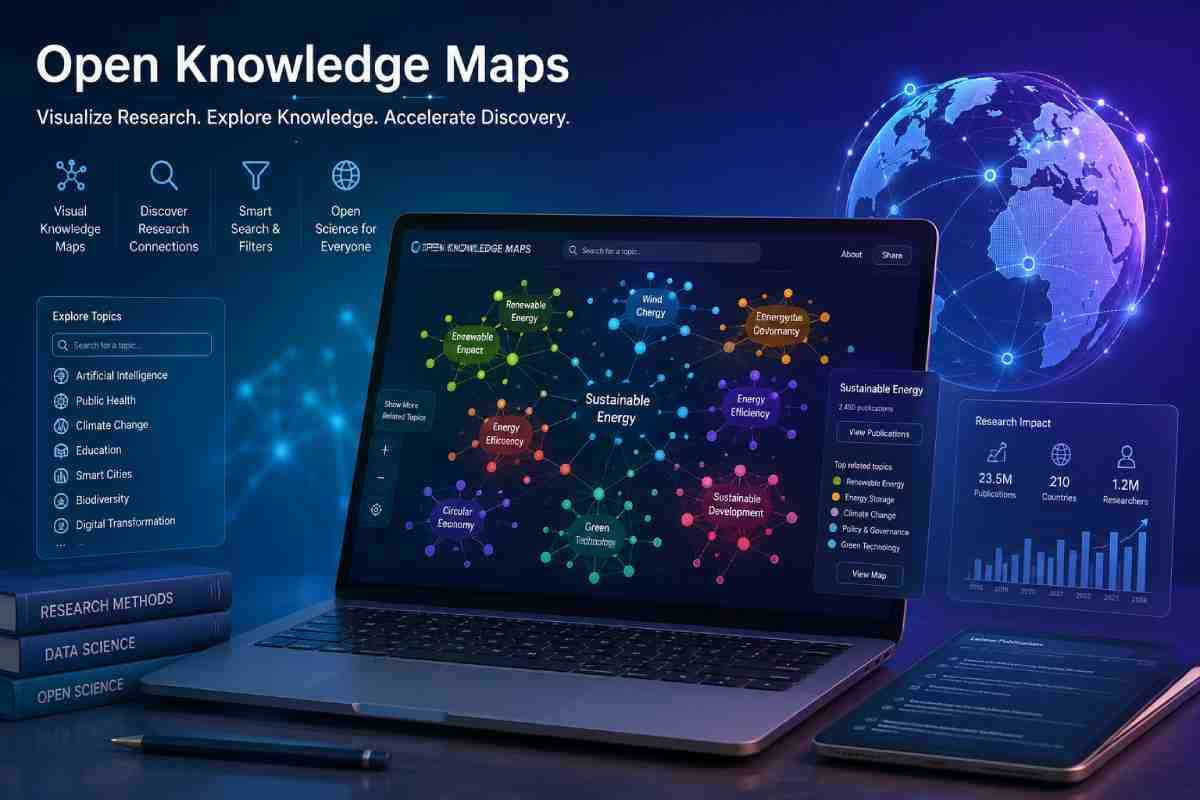
Open Knowledge Maps doesn’t display a plain list of papers. It visually groups papers by research topic in various colors to make reviewing and cross-exploring work within a few minutes easier.
Over the last couple of years, many Indonesian universities, researchers, and students have started to use digital research tools to improve their literature reviews and writing. Open Knowledge Maps has been one of the top recommended free tool; it helps to visualize scientific knowledge and even makes it easier to explore.
This tutorial provides you with information about Open Knowledge Maps in Indonesia, how to use it, its contents, strengths and weaknesses, comparison to other research tools, and instructions to maximize its use.
Table of Contents
What is Open Knowledge Maps?

Open Knowledge Maps is a free online research discovery system and visualization of science. Similar to Google scholar but we map scientific documents and generate collaborative knowledge maps instead of returning long lists of papers. Each topic bubble can display clusters of scientific document grouped by sub-topics.
For example, if you search for:
- Renewable Energy Indonesia
- Artificial Intelligence
- Climate Change
- Public Health
- Digital Education
The platform automatically creates a visual research map showing different branches of the topic.
This approach helps users understand complex subjects much faster than scrolling through hundreds of search results.
Definition of Open Knowledge Maps
| Feature | Description |
| Platform Type | Academic Knowledge Discovery Tool |
| Cost | Free |
| Main Purpose | Visual exploration of research papers |
| Users | Students, Researchers, Professors, Universities |
| Research Sources | Crossref, PubMed, OpenAIRE and more |
| Availability | Worldwide including Indonesia |
| Website Access | Browser-based |
Why is Open Knowledge Maps Popular in Indonesia?

Indonesia has millions of university students and thousands of active researchers. Academic institutions increasingly encourage students to use peer-reviewed journals instead of relying on random internet articles.
Open Knowledge Maps helps Indonesian users because it:
- Saves research time
- Organizes literature visually
- Supports systematic reviews
- Helps identify research gaps
- Encourages open science
- Works without expensive subscriptions
It is especially valuable for:
- Undergraduate students
- Master’s students
- PhD candidates
- Lecturers
- Research institutions
- Government researchers
- Healthcare professionals
How Open Knowledge Maps Works
The platform uses artificial intelligence and text analysis to organize publications.
The process is surprisingly simple.
Step 1: Enter a Keyword
Example:
- Digital Marketing Indonesia
- Smart Cities
- Islamic Banking
- Tourism Indonesia
Step 2: Analyze Publications
The system searches academic databases for relevant publications.
Step 3: Group Similar Papers
Instead of displaying a list, similar studies are grouped together.
Step 4: Build a Visual Map
The result is an interactive knowledge map where each bubble represents a research topic.
Step 5: Explore Related Research
Users can click any cluster to view:
- Article titles
- Authors
- Abstracts
- Keywords
- Related publications
Major Features of Open Knowledge Maps
1. Interactive Research Visualization
Instead of reading endless search pages, users explore colorful research clusters.
2. Literature Discovery
Researchers often discover relevant papers they would have missed using traditional keyword searches.
3. Open Access Focus
Many linked articles are freely available.
4. Easy Navigation
Even beginners can understand research relationships visually.
5. Fast Topic Exploration
The platform provides a quick overview of an entire research field.
6. Citation Support
Researchers can access publication details for referencing.
7. User-Friendly Interface
No advanced technical knowledge is required.
Key Benefits for Indonesian Students
Many Indonesian universities now emphasize evidence-based learning.
Open Knowledge Maps supports this by helping students:
- Prepare assignments
- Write theses
- Conduct literature reviews
- Identify credible sources
- Understand research trends
- Improve academic writing
Benefits for Indonesian Researchers
Researchers gain several advantages.
| Benefit | Explanation |
| Faster Literature Review | Discover papers quickly |
| Better Topic Understanding | View research clusters |
| Identify Research Gaps | Find unexplored areas |
| Save Time | Reduce manual searching |
| Increase Productivity | Organize references efficiently |
| Improve Collaboration | Discover related authors |
Comparison: Open Knowledge Maps vs Traditional Search Engines
| Feature | Open Knowledge Maps | Google Search | Google Scholar |
| Visual Maps | Yes | No | No |
| Academic Focus | Yes | Partial | Yes |
| Research Clusters | Yes | No | No |
| Free Access | Yes | Yes | Yes |
| Open Science Support | High | Low | Moderate |
| Literature Discovery | Excellent | Moderate | Good |
| Beginner Friendly | Excellent | Good | Good |
Open Knowledge Maps vs Google Scholar
Although both platforms help locate academic literature, they serve different purposes.
| Feature | Open Knowledge Maps | Google Scholar |
| Main Focus | Research Visualization | Citation Search |
| User Interface | Visual | Text List |
| Literature Review | Excellent | Good |
| Citation Tracking | Limited | Excellent |
| Research Discovery | Outstanding | Very Good |
| Topic Mapping | Yes | No |
Many researchers actually use both together.
Common Research Topics Searched in Indonesia
Some of the most popular searches include:
| Topic | Example |
| Education | Digital Learning |
| Agriculture | Sustainable Farming |
| Healthcare | Public Health |
| Environment | Climate Change |
| Artificial Intelligence | Machine Learning |
| Economics | MSMEs in Indonesia |
| Tourism | Bali Tourism |
| Renewable Energy | Solar Power |
| Marine Science | Coral Reefs |
| Finance | Islamic Banking |
Advantages of Visual Research Maps
Visual learning significantly improves understanding.
Instead of reading 300 article titles, users immediately recognize:
- Major research themes
- Emerging topics
- Frequently studied subjects
- Under-researched areas
- Relationships between disciplines
This is particularly useful during thesis preparation.
How Indonesian Students Can Use Open Knowledge Maps
For Literature Reviews
Locate the most important studies before writing.
For Thesis Writing
Identify existing research and research gaps.
For Assignments
Quickly gather trustworthy academic references.
For Journal Publications
Understand previous studies before publishing new work.
For Research Proposals
Build stronger background sections supported by existing literature.
Best Practices When Using Open Knowledge Maps
To get better results:
- Use specific keywords.
- Try different search terms.
- Combine English and Indonesian keywords.
- Explore multiple clusters.
- Read abstracts carefully.
- Verify publication quality.
- Download available full-text papers.
- Cross-check references.
Limitations of Open Knowledge Maps
Although impressive, no research tool is perfect.
| Limitation | Explanation |
| Depends on Indexed Databases | Missing databases mean missing papers |
| Limited Citation Analytics | Not designed for citation analysis |
| No Full Text for Every Article | Some journals remain subscription-based |
| Keyword Sensitive | Better keywords produce better maps |
| Internet Required | Browser-based platform |
Tips for Better Academic Research
Experienced researchers often follow a workflow like this:
- Start with Open Knowledge Maps.
- Understand the research landscape.
- Open interesting clusters.
- Read abstracts.
- Save relevant papers.
- Search additional references.
- Build your literature review.
- Organize citations using reference managers.
Open Knowledge Maps for Universities in Indonesia
Many universities encourage digital research methods.
The platform supports:
- Academic libraries
- Faculty research
- Graduate programs
- Research centers
- Scientific publications
- Collaborative research
It aligns well with Indonesia’s growing emphasis on open science and digital scholarship.
Who Should Use Open Knowledge Maps?
Almost anyone involved in academic work can benefit.
| User | Why It Helps |
| Students | Easier literature search |
| Teachers | Better teaching resources |
| Professors | Faster research reviews |
| PhD Scholars | Discover research gaps |
| Journal Authors | Improve manuscript preparation |
| Librarians | Support information literacy |
| Policymakers | Access evidence-based research |
Practical Example
Imagine you’re writing a thesis on “Renewable Energy in Indonesia.”
Instead of reading hundreds of unrelated papers, Open Knowledge Maps may organize results into clusters such as:
- Solar Energy
- Wind Energy
- Hydropower
- Bioenergy
- Government Policy
- Rural Electrification
- Carbon Emissions
- Energy Storage
This visual organization immediately helps you understand how the field is structured and where your research can contribute.
Common Mistakes to Avoid
Many beginners make avoidable errors.
- Searching with very broad keywords
- Ignoring related clusters
- Using only one search
- Not checking publication dates
- Relying on a single source
- Skipping abstracts
- Not verifying peer-reviewed journals
Future of Open Knowledge Maps in Indonesia
Indonesia’s research ecosystem continues to expand with greater emphasis on digital access and open science. As universities invest more in online learning, institutional repositories, and international collaboration, visual discovery platforms are expected to become even more valuable.
Future developments may include:
- Enhanced AI-powered topic recommendations
- Broader integration with institutional repositories
- More multilingual support, including Indonesian-language metadata
- Improved collaboration features for research teams
- Smarter filtering by discipline, publication type, and methodology
For students and researchers, this means quicker access to relevant knowledge and more efficient literature exploration.
Frequently Asked Questions (FAQs)
Is Open Knowledge Maps free to use?
Yes. Open Knowledge Maps is free and accessible through any modern web browser.
Can Indonesian students use Open Knowledge Maps?
Absolutely. Students, lecturers, and researchers in Indonesia can use it without geographic restrictions.
Does Open Knowledge Maps provide full-text articles?
Not always. It links to available publications, and many are open access. Some articles may still require access through publishers or institutional subscriptions.
Is it better than Google Scholar?
They serve different purposes. Open Knowledge Maps excels at visual topic exploration, while Google Scholar is stronger for citation tracking and comprehensive article searches.
Can I use Open Knowledge Maps for a thesis?
Yes. It is particularly helpful for literature reviews, identifying research themes, and finding related studies before beginning your writing.
Which academic fields are supported?
The platform covers a wide range of disciplines, including engineering, medicine, education, social sciences, environmental studies, economics, computer science, and more.
Final Thoughts
Open Knowledge Maps is set to make discovering scientific research easier than ever, as they turn these lengthy text-based search-results into interactive visual representations – knowledge maps. They are a really useful tool to grasp a broad concept, delve into a subject, and identify promising areas of study, as opposed to hours wading through search results for students and educators; particularly for Indonesian’s, this really could make life easier in their academic journey.
I would not use Open Knowledge Maps as a substitute for all traditional databases; however, I would use it as an introductory stepping stone, prior to consulting other sources of research. It could work in conjunction with Google Scholar and library accounts and significantly help you focus your research with a greater knowledge and more streamlined.