

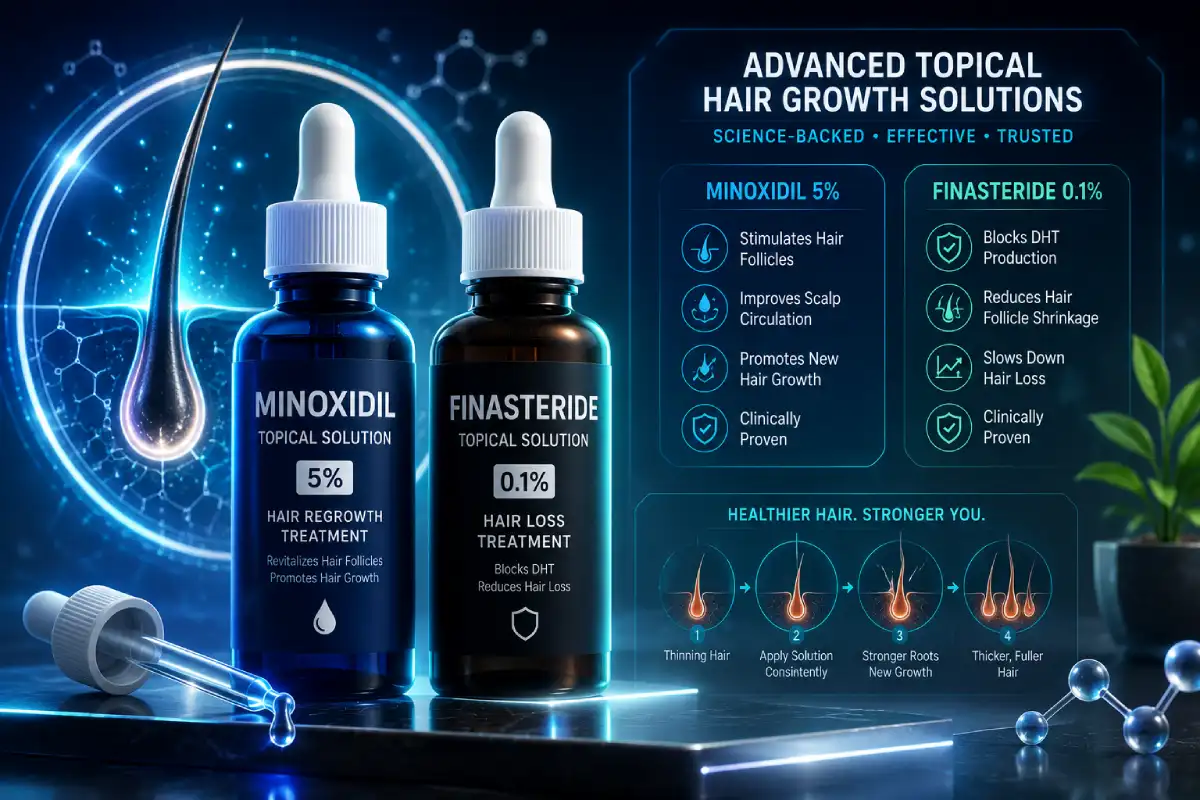
Hair loss can significantly impact a person’s appearance, confidence, and mental health. From a receded hairline to a thinning scalp to an alarming amount of hair shedding, a wide range of people have long searched for hair loss solutions that deliver real results. Today, the hair loss treatment that most frequently comes up among discussions and recommendations from dermatologists is Minoxidil and Finasteride topical solution.
This treatment plan has become increasingly sought after because of its ability to attack the cause of hair loss from two different points: the hormones that cause hair thinning in the first place and a stimulate that can encourage growth.
In the treatment of androgenetic alopecia, which can affect both males and females, this combination treatment has shown great success and continues to be a front runner among non-surgical options.
Table of Contents
What Are Minoxidil and Finasteride Topical Solutions?
Description The topical solutions of minoxidil and finasteride are treatments to stimulate the growth of hair on the scalp. This dual formula consists of two proven elements:
- Minoxidil – A vasodilator that improves blood circulation around hair follicles and promotes growth.
- Finasteride – A DHT blocker that helps prevent hair follicle shrinkage caused by dihydrotestosterone (DHT).
Together these work as an all-in-one hair thinning product that help to prevent hair loss and support healthier growth. Minoxidil and Finasteride Topical Solution Minoxidil and Finasteride topical solution is a scalp prescription, or a dermatologist-suggested hair growth treatment.
This remedy helps in managing the causes and effect of androgenetic alopecia by the stimulation of hair and prevention of the loss of hair growth due to DHT.
Understanding Hair Loss Before Treatment
To understand how to resolve it, we have to understand why we lose our hair.
Hair follicles naturally go through growth cycles:
| Hair Growth Phase | Description | Duration |
| Anagen | Active growth phase | 2–7 years |
| Catagen | Transitional phase | 2–3 weeks |
| Telogen | Resting phase | 2–4 months |
| Exogen | Shedding phase | Ongoing |
DHT constricts hair follicles until the hairs become too thin for any more hair to grow (androgenetic alopecia).
How Does Minoxidil Work?
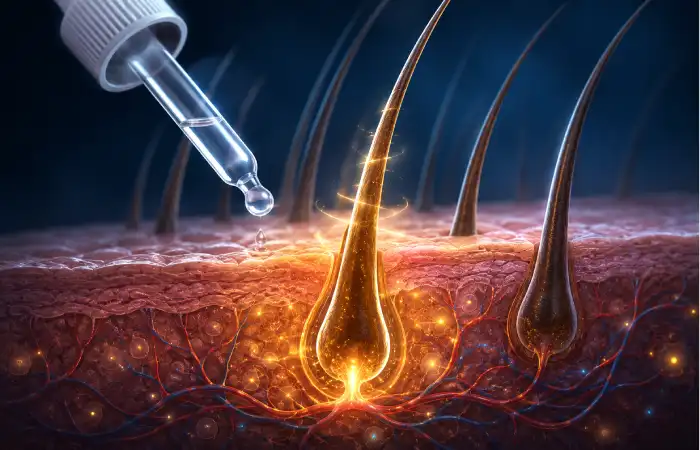
Minoxidil is a high blood pressure treatment; while it was being clinically tested researchers noticed it promoted hair growth.
It is now among the leading baldness treatments in the market all over the globe.
Benefits of Minoxidil
- Increases blood supply to follicles
- Extends hair growth phase
- Stimulates dormant follicles
- Improves hair density
- Promotes thicker hair strands
What Happens After Application?
When applied to the scalp:
- Minoxidil penetrates hair follicles.
- Blood vessels expand.
- Oxygen and nutrients reach follicles more effectively.
- Hair growth cycles improve.
- New hair begins emerging over time.
How Does Finasteride Work?
Finasteride addresses one of the leading causes of male pattern baldness—DHT.
Understanding DHT
DHT (Dihydrotestosterone) is a hormone derived from testosterone.
In genetically sensitive individuals:
- DHT binds to hair follicles.
- Follicles shrink gradually.
- Hair becomes thinner.
- Growth eventually stops.
Finasteride blocks the enzyme responsible for DHT production.
Benefits of Finasteride
| Benefit | Impact |
| DHT Reduction | Prevents follicle miniaturization |
| Hair Retention | Slows hair loss |
| Improved Density | Supports thicker hair growth |
| Long-Term Results | Maintains existing hair |
| Better Follicle Health | Enhances growth environment |
Why Combine Minoxidil and Finasteride?
Individually, both treatments are effective.
Together, they become even more powerful.
Dual Mechanism Advantage
| Feature | Minoxidil | Finasteride |
| Stimulates Growth | ✓ | No |
| Increases Blood Flow | ✓ | No |
| Reduces DHT | No | ✓ |
| Prevents Follicle Shrinkage | No | ✓ |
| Supports New Hair Growth | ✓ | ✓ |
| Maintains Existing Hair | Moderate | Strong |
Together these treat the effects and root causes of hair loss.
Benefits of Minoxidil and Finasteride Topical Solution
The combo topical product is many people’s preference because there are many benefits.
1. Improved Hair Density
Most people notice thicker and fuller hair after prolonged use.
2. Reduced Hair Fall
After continuous use of the product hair fall gradually gets less.
3. Better Hairline Maintenance
The treatment may help preserve existing hairline structure.
4. Convenient Application
All active ingredients can be provided in one solution.
5. Reduced Systemic Exposure
Using a topical route of administration has the potential to be absorbed into the whole body more slowly than taking it by mouth.
Who Can Use Minoxidil and Finasteride Topical Solution?
This treatment is generally recommended for:
Suitable Candidates
- Men with androgenetic alopecia
- Early-stage hair loss sufferers
- Receding hairline patients
- Crown thinning individuals
- People looking to maintain hair density
Not Suitable Without Medical Advice
- Pregnant women
- Breastfeeding mothers
- Individuals with scalp infections
- People allergic to ingredients
- Children
Common Concentrations Available
Different formulations are available depending on the manufacturer and prescription.
| Ingredient | Common Strength |
| Minoxidil | 2%, 5%, 10% |
| Finasteride | 0.1%, 0.25%, 0.5% |
The most frequently prescribed combination is:
Minoxidil 5% + Finasteride 0.1%
How to Apply Minoxidil and Finasteride Topical Solution
Proper application plays a major role in achieving results.
Step-by-Step Guide
Step 1: Clean the Scalp
Ensure your scalp is dry and free from excessive oil.
Step 2: Measure the Recommended Dose
Follow your dermatologist’s instructions carefully.
Step 3: Apply Directly to Affected Areas
Focus on thinning areas.
Step 4: Massage Gently
Spread evenly using fingertips.
Step 5: Allow It to Dry
Avoid washing your hair immediately after application.
Application Schedule Example
| Time | Action |
| Morning | Apply prescribed amount |
| Evening | Reapply if instructed |
| Daily | Consistency is essential |
What Results Can You Expect?
Hair regrowth is a gradual process.
Patience is important.
Typical Timeline
| Time Period | Expected Changes |
| 1 Month | Possible initial shedding |
| 2–3 Months | Reduced hair fall |
| 3–6 Months | New growth begins |
| 6–9 Months | Improved density |
| 9–12 Months | Noticeable thickening |
Results vary based on:
- Age
- Genetics
- Hair loss severity
- Treatment consistency
- Overall health
Why Initial Shedding Happens
Many users become concerned when hair shedding increases during the first few weeks.
This is often a temporary process called shedding phase.
Why It Occurs
Older weak hairs fall out to make room for healthier growing hairs.
In many cases, shedding indicates that the treatment is beginning to work.
Minoxidil and Finasteride Topical Solution vs Oral Finasteride
One common question is whether topical therapy is better than oral medication.
| Factor | Topical Solution | Oral Finasteride |
| Application | External | Oral Tablet |
| Targets Scalp Directly | Yes | Indirectly |
| Systemic Exposure | Lower | Higher |
| Convenience | Moderate | High |
| Localized Treatment | Yes | No |
| Dermatologist Preference | Growing Popularity | Traditional Option |
The choice often depends on individual goals and medical advice.
Possible Side Effects
Like any treatment, side effects are possible.
Most are mild and temporary.
Common Side Effects
| Side Effect | Frequency |
| Scalp Itching | Common |
| Dryness | Common |
| Mild Redness | Common |
| Flaking | Occasional |
| Temporary Shedding | Common |
Less Common Effects
- Scalp irritation
- Burning sensation
- Increased sensitivity
- Allergic reactions
Seek professional medical advice if your symptoms become severe.
Tips for Better Hair Growth Results
For best results, combine treatments with proper hair care practices.
Maintain a Healthy Diet
Include:
- Protein-rich foods
- Iron sources
- Zinc-rich foods
- Vitamin D
- Biotin-containing foods
Reduce Stress
Excessive hair loss may also result from long-term tension or stress.
Helpful activities include:
- Walking
- Meditation
- Yoga
- Quality sleep
Avoid Harsh Hair Practices
Limit:
- Excessive heat styling
- Tight hairstyles
- Frequent chemical treatments
Stay Consistent
Consistency has been the major element of our success. The success with any of the treatments can diminish by missing applications more frequently than it is being prescribed.
Common Myths About Minoxidil and Finasteride Topical Solution
Myth 1: Hair Grows Overnight
Hair growth takes months, not days.
Myth 2: More Product Means Faster Results
Overapplication does not accelerate growth.
Myth 3: Results Are Permanent Without Continued Use
Stopping treatment may allow hair loss to resume.
Myth 4: Only Older Men Need It
Hair loss can begin in the twenties or even earlier.
Comparison of Popular Hair Loss Treatments
| Treatment | Hair Growth | Prevents Hair Loss | Non-Surgical | Convenience |
| Minoxidil | Excellent | Moderate | Yes | High |
| Finasteride | Moderate | Excellent | Yes | High |
| Combined Topical Solution | Excellent | Excellent | Yes | High |
| PRP Therapy | Good | Good | Semi-Clinical | Moderate |
| Hair Transplant | Excellent | Limited | No | Low |
Long-Term Maintenance and Expectations
Treating hair loss is not a sprint, it is a marathon.
For many, “treatment” sounds like a project. In reality, managing hair loss is more like managing a fitness plan. For fitness results to remain, you still need to workout, and for those hair loss results to remain, you generally still need to use your product. The best approach for most is consistent use and application year after year to maintain a more youthful and full-looking appearance of your hair.
Frequently Asked Questions
Are Minoxidil and Finasteride topical solutions effective?
Yes. In our clinical experience and dermatological practice we have found that Finasteride + Minoxidil is more effective than just one ingredient alone in most men with androgenetic alopecia.
Can women use this treatment?
Products must only be applied in the amounts recommended by the healthcare provider because, in some cases, Finasteride may not be appropriate.
How long should I use it?
Some users need a few months to see results. Often, you’ll need to use it on an ongoing basis to continue seeing the effects.
Can I apply it after washing my hair?
Yes. Best if applied to a clean, totally dry scalp.
Does it work on bald areas?
Works best in areas where hair follicles are still alive. It’s possible that a dead follicle may be non-responsive to a treatment.
Can I use hair oil with it?
Yes, just do not oil your hair before and after the procedure as advised by your dermatologist.
Final Thoughts
The topical Minoxidil and Finasteride combination has become one of the top surgical options in non-surgical hair loss treatments. This treatment has become effective to treat both the visible signs and symptoms of pattern hair loss and the root cause. The Minoxidil encourages hair growth while the Finasteride helps block the DHT which is an androgen that causes androgenetic alopecia.
Though it takes time and consistency to see the desired results, several individuals have noted a significant decrease in hair loss and better hair growth and density. Start now, use consistently, keep your expectations grounded, and follow medical guidance from your doctors.