

Summary Helvetic Clinics in Budapest, Hungary offers dental implants to UK patients at 50–70% below UK private rates — from £830 per single implant versus £2,000–£5,500 in the UK. The clinic uses premium implant brands including Megagen, Straumann, and Astratech, employs dedicated implantologists (not general dentists), and holds ISO 9001 certification with Global Clinic Rating’s top Hungary ranking since 2014. Dental implants require a biological healing phase of 3–6 months (osseointegration) between the surgical placement and final crown fitting — meaning most patients need at least two trips. This article covers the implant science, procedure stages, what to expect clinically, implant brand quality, and the honest risks UK patients must understand before booking.
If you have been searching for dental implants abroad Helvetic Clinics, you are almost certainly trying to answer one real question: can I get genuinely good dental implants in Budapest for a fraction of what a UK private clinic would charge — and if so, what exactly does that involve?
The short answer is yes. The longer answer — which is the only one worth having before you make a surgical decision — involves understanding what a dental implant actually is, what Helvetic Clinics specifically does, what happens biologically during the healing process, what brands and materials are used, and where the genuine risks lie.
This guide covers all of it. By the end, you will be able to walk into any consultation — Budapest or otherwise — knowing exactly what questions to ask and what answers to accept.
Table of Contents
Why UK Patients Are Choosing Dental Implants Abroad in 2026
With the ongoing cost-of-living crisis and limited NHS dental access, many UK residents are turning their gaze toward overseas options to restore their smiles. Clinics like Helvetic Clinics in Budapest, Hungary have become household names in the dental tourism industry, promising significant savings, modern facilities, and the chance to combine treatment with a holiday.
The financial reality driving this decision is stark:
A single dental implant in the UK can cost between £2,000 and £2,800 depending on the clinic and type of restoration. In Hungary, prices are advertised at £900 to £1,200.
For patients needing multiple implants, full-arch All-on-4 restorations, or complete mouth rehabilitation, the savings run into the tens of thousands — even after accounting for flights and accommodation. That is not a marginal discount; it is a life-changing financial difference for many patients.
What Is a Dental Implant? The Science Explained Simply
Before evaluating any clinic, understanding what you’re actually buying matters. A dental implant is not simply a false tooth. It is a three-part system that replaces both the root and the crown of a missing tooth.
The three components:
| Component | What It Is | Material |
|---|---|---|
| Implant fixture | Titanium screw placed into the jawbone | Medical-grade titanium |
| Abutment | Connector piece between fixture and crown | Titanium or zirconia |
| Crown | The visible tooth replacement | Porcelain, zirconia, or ceramic |
The reason implants are so different from dentures and bridges is osseointegration — the biological process by which the titanium fixture fuses with the living bone. Osseointegration is what makes dental implants different from dentures and bridges. When an implant fuses to your jawbone, it offers the only tooth replacement option that helps maintain jawbone health, because it acts like a natural tooth root.
Osseointegration has proven to be a biologically sound foundation for contemporary dental implant therapy. The formation of bone at the titanium dental implant surface is dependent on osteoprogenitor cell recruitment, proliferation, and differentiation — and the current relatively high success of dental implant therapy is due, in part, to the effects of enhanced surface topography on implant-adherent cell functions.
In plain terms: your jawbone grows into and around the titanium surface of the implant, locking it in place as securely as a natural root. This is why implants can last 20–30 years with proper care — and why the healing period cannot be bypassed without compromising that outcome.
What Is Helvetic Clinics? The Implant-Specific Picture
Helvetic Clinics employs a team of highly skilled and experienced dental professionals who utilise state-of-the-art technology and adhere to international standards. The clinic offers premium implant brands including Megagen, Astratech, and Straumann, ensuring durability and high success rates.
Helvetic Clinics uses strict specialisation: Implantologists only place implants. Odontologists handle decay. Periodontists handle gum work.
This specialist separation is clinically significant. In a typical UK general dental practice, the dentist who fills your cavities, cleans your teeth, and fits your crowns may also be the person placing your implant. This is not necessarily a quality problem — many general dentists are excellent implantologists — but it is fundamentally different from a clinic where the implantologist’s only daily procedure is implant placement. Volume and specialisation build procedural expertise in ways that general practice cannot replicate at the same scale.
Helvetic Clinics has garnered a reputation for its high standards of care and customer satisfaction, with an impressive rating of 4.9 from over 1,700 reviews. Located at Révay u. 12, 1065 Budapest, the clinic offers a variety of dental procedures to meet the needs of international patients.
The Implant Brands Used at Helvetic Clinics
This is a question most patients forget to ask — and one of the most important. The implant brand determines the quality of the titanium surface, the design of the implant-bone interface, and critically for UK patients, whether your local dentist can service the implant after you return home.
Helvetic Clinics offers premium implant brands including Megagen, Astratech, and Straumann, ensuring durability and high success rates. For instance, a Megagen AnyOne Implant is priced at €680, whereas the same procedure can cost between £950 and £2,000 in the UK.
Here is what each of these brands represents:
Straumann — A Swiss-headquartered company and the gold standard of implant brands globally. Straumann implants are used in more peer-reviewed clinical research than any other brand. Their SLActive surface technology is one of the most studied in implant dentistry. UK dentists universally recognise and can service Straumann components.
Astratech (now part of Dentsply Sirona) — A Swedish-origin system with over 30 years of clinical data. Known for its OsseoSpeed surface (later BioManage) and MicroThread design that distributes occlusal forces more evenly across the bone-implant interface, reducing marginal bone loss. Widely used in academic and hospital dentistry.
Megagen AnyOne — A South Korean system that has gained significant European market share in the last decade. Well-documented clinically, with the AnyRidge system in particular showing strong osseointegration data across bone density types. At the lower end of the Helvetic pricing tier, this represents strong value for straightforward single-tooth cases.
Turkey’s major dental clinics use the same internationally certified implant systems — such as Straumann, Nobel Biocare, and others — as clinics in the UK and Europe. The same applies to Hungary. The implant system matters more than the country it is placed in — and at Helvetic Clinics, the brands used are internationally recognised, not proprietary or budget alternatives.
Critical question to ask before booking: Which specific implant brand and model will be used in my case? Request the full INCI-equivalent detail: manufacturer, product line, implant diameter and length planned. This information should appear in your written treatment plan and discharge documentation.
The Full Dental Implant Procedure: Stage by Stage
Understanding what actually happens — and when — is the most important foundation for evaluating any overseas implant clinic’s proposed timeline.
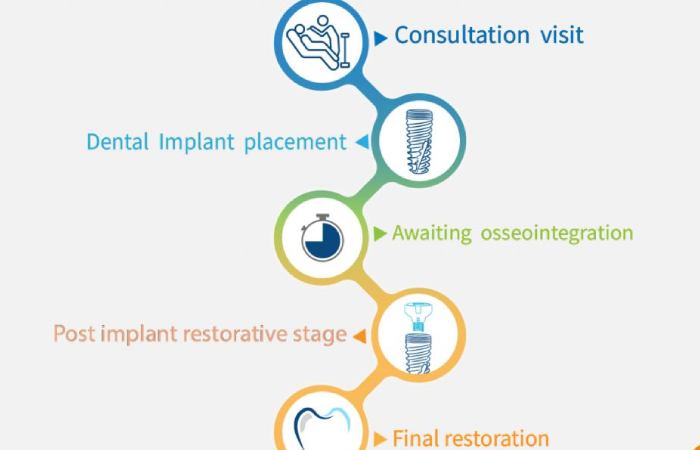
Stage 1: Consultation and Diagnostic Imaging (Before Travel)
For international patients, Helvetic Clinics offers initial remote consultation based on photographs and any existing X-rays. However, a proper implant diagnosis requires a CBCT (Cone Beam Computed Tomography) scan — a 3D imaging modality that maps bone volume, bone density, the location of nerve canals, and the sinus floor anatomy that determine where implants can safely be placed and at what dimensions.
Helvetic Clinics uses cutting-edge tools to deliver top-notch care. 3D imaging, digital planning, and guided implant surgery allow for pinpoint accuracy, ensuring implants are placed with the highest degree of precision and comfort.
This CBCT is typically performed on arrival at the clinic for the first visit. Do not accept a treatment plan and price quote based solely on a photograph or a dental panoramic X-ray (OPG) — a 2D image does not provide the bone volume data needed for implant planning.
Stage 2: Preparatory Treatments (If Required)
Before implant placement can happen, several conditions must be met:
Bone grafting: If bone volume at the implant site is insufficient to support a fixture of adequate dimensions, a bone graft — adding bone material to the area — is required. This typically adds healing time of 4–6 months before implant placement. Bone grafting procedures incur additional charges and are not included in standard implant package pricing. Always ask whether your treatment plan includes or excludes this.
Gum health: Active gum disease (periodontitis) must be treated before implant placement. Bacteria at the implant site significantly increase the risk of peri-implantitis — an infection of the tissue around the implant that is one of the most common causes of implant failure. Helvetic’s periodontist team handles this as part of their specialisation model.
Extractions: Teeth that are beyond saving must be extracted before or at the time of implant placement, with appropriate healing time allowed in most cases.
Stage 3: Implant Placement Surgery
This is the primary surgical visit. Under local anaesthesia (and sedation if requested), the implantologist makes a small incision in the gum, prepares the bone with a series of precision drills, and inserts the titanium fixture. The gum is then sutured, and a healing cap or temporary restoration is placed.
Guided implant surgery using digital planning allows for pinpoint accuracy in implant placement, ensuring the fixture is positioned with the highest degree of precision and comfort.
The procedure itself is typically 45–90 minutes per implant under local anaesthesia. Discomfort during the procedure is managed; post-operative soreness is normal for 3–7 days and managed with standard analgesics.
Stage 4: Osseointegration — The Healing Phase
This is the stage most patients underestimate — and the stage that determines whether the implant succeeds or fails.
Osseointegration takes an average of 3–6 months, though it can vary based on factors like bone quality, overall health, and whether you smoke. During this time, patients must follow their dentist’s instructions, such as eating soft foods and maintaining good oral hygiene, to support healing.
Studies demonstrate immediate loading success rates comparable to conventional loading (95–97%) when proper case selection criteria are applied — requiring excellent primary stability (greater than 45 Ncm of insertion torque), adequate bone volume, and precise prosthetic execution.
What this means practically: whether you can have a temporary tooth fitted on the same day as surgery depends on the stability achieved during placement, the bone quality of your specific site, and the clinical judgment of the implantologist — not on the clinic’s marketing promises. A responsible clinic will assess this intraoperatively and tell you honestly what is and is not appropriate for your case.
With proper care, dental implant treatment has a success rate of 96.4% over 10 years, according to one meta-analysis. Factors like oral hygiene, smoking, and bone density affect outcomes. Smoking slows blood flow and delays healing — patients should avoid smoking before and after surgery.
Key facts that affect your osseointegration timeline:
| Factor | Effect on Healing |
|---|---|
| Smoking | Significantly slows healing; increases failure risk |
| Uncontrolled diabetes | Impairs bone healing and increases infection risk |
| Osteoporosis / bisphosphonate use | May contraindicate implants without specialist assessment |
| Upper jaw vs lower jaw | Upper jaw (maxilla) heals more slowly — up to 7 months |
| Bone graft sites | Require full graft maturation before loading |
| Age and general health | Influences overall healing rate |
Stage 5: Abutment Placement and Final Crown Fitting (Second Trip)
Once osseointegration is confirmed — typically by clinical testing and follow-up X-rays — the abutment is attached to the fixture. This minor procedure may require a short healing period of 1–2 weeks if the gum tissue needs to recover. Once healed, impressions are taken to create a custom crown, bridge, or denture. Crafting and fitting the final restoration typically takes 2–4 weeks.
For UK patients at Helvetic Clinics, this means the second Budapest trip typically covers abutment placement and final crown or bridge fitting in the same visit, with laboratory work completed during the stay.
What Immediate Loading and All-on-4 Mean for the Timeline
All-on-4 is the most searched and most misunderstood procedure in dental tourism. Here is the clinical reality.
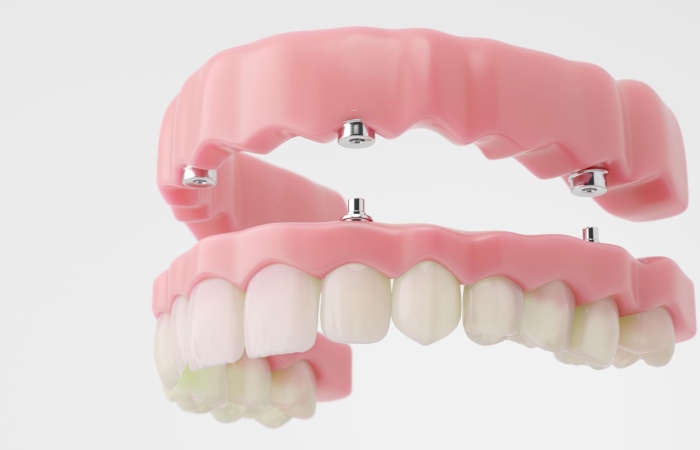
All-on-4 replaces an entire dental arch (upper or lower jaw) using four strategically placed implants. The posterior two implants are angled (typically at 30–45 degrees) to maximise contact with available bone without requiring bone grafts in most cases. A full-arch fixed bridge is then attached.
The mandible (lower jaw) consistently demonstrates slightly higher survival rates than the maxilla (upper jaw). The lower jaw contains denser cortical bone, higher density improves primary stability, and strong primary stability enhances osseointegration.
When done correctly, All-on-4 allows immediate provisional teeth (temporary fixed teeth, not removable dentures) on the day of surgery. This is clinically valid for appropriate patients. The final prosthetic — harder, more durable, and aesthetically refined — is fitted after the osseointegration period, typically 3–6 months later on a second trip.
An All-on-4 full-arch restoration starts at around £4,500 per jaw at Helvetic Clinics — versus £12,000–£25,000 or more in the UK private market.
This is where the mathematics of dental tourism become most compelling for UK patients. The saving on a full dual-arch rehabilitation can exceed £20,000 — comfortably covering multiple Budapest trips, extended hotel stays, and still leaving the patient financially ahead.
Honest Costs: What the Helvetic Clinics Quote Does and Does Not Include
While the cost of a single implant in the UK can be upwards of £2,000, the same procedure at Helvetic Clinics may cost around £830, including the abutment and crown.
| Procedure | Helvetic Clinics Budapest | UK Private Range | Saving |
|---|---|---|---|
| Single Implant (fixture + abutment + crown) | From £830 | £1,800–£5,500 | £970–£4,670 |
| Megagen AnyOne Implant | ~£680 (€680) | £950–£2,000 | £270–£1,320 |
| 3-Unit Implant Bridge (2 implants) | From £1,800 | £4,000–£9,000+ | £2,200–£7,200 |
| All-on-4 (single jaw) | From £4,500 | £12,000–£20,000+ | £7,500–£15,500 |
| All-on-4 (both jaws) | From £9,000 | £24,000–£35,000+ | £15,000–£26,000 |
| CT Scan / CBCT | Often included | £150–£400 separately | Variable |
| Bone Graft | Extra charge | Extra charge | N/A |
What to verify is included in your quote:
- CT/CBCT diagnostic imaging
- All surgical appointments
- Temporary/provisional restorations
- Abutments (these can be quoted separately)
- Final crown or bridge material (zirconia vs porcelain-fused-to-metal)
- Post-operative medications
- Follow-up appointments during your stay
Raw numbers alone can mislead. A cheaper quote with weaker documentation is usually not better value — it is usually higher uncertainty. The most stressful part of treatment abroad is not the surgery; it is not knowing what happens if something needs review after returning home.
What are the actual risks and how do you control them?
Wherek are UK dentists starting to see an increase in the number of patients with treatment taken abroad? 80% of UK dentists are seeing an increase in patients with complications from treatment abroad. Your initial saving can be lost very quickly.
This is a true and valid warning are not an excuse to write off dental tourism entirely. It‘s just something to think about and one reason to chart out the management plan before, not after, you arrive in your destination.
Risk 1:
Implant failure requiring re-treatment Implant failure can happen with the best of operators. The 10-year overall success rate worldwide of around 96.4% mean that between 3 and 4 in 100 implants placed need some form of re-treatment within 10 years. That transplant in Budapest can be a problem when you are in Birmingham.
Mitigation: choose UK dentist prepared to deal with complications following the placement and to maintain an implant placed elsewhere. Take all records with you including CBCT data, brand and size of implant and type of abutment, to aid your UK dentist.
Risk 2:
Rushed osseointegration times Offshore clinics will get every possible toab between possible on the same set of implants in order to accommodate them for their holiday period. The result may be too early placement of the final teeth and subsequent implant failure or insufficient time to deal with complications such as post operative infection.
Mitigation: Questions to Helvetic Clinics: “From my first surgical visit, how soon can I expect the second visit for my restoration?” Anything less than three months (assuming this is for a lone implant on normal bone) should lead to very detailed questions. All-on-4 immediately provisionalized is an acceptable reason however, prosthetic should be postponed to allow complete osseointegration.
Risk 3:
documentation gaps There is an easy way to cut risk of uncertainty in post treatment: consider documentation as integral to treatment, not a luxury.
Mitigation: Request in advance, in writing full removal pack (titles, company, model/diameter/length for each fixture inserted, abutments, post-op instructions, follow up plan). Your UK dentist will require this so he/she can provide any servicing or cope with any problems.
4.
UK does not offer a regulatory remedy. The UK dental industry is closely monitored. If at home a dentist has to be registered with the GDC and the clinics are looked after by the CQC. The import country has a very different process to dealing with problems.
Mitigation: Can‘t be removed entirely. Opt for clinic with independently verifiable accreditation (ISO, GCR membership, verifiable Trustpilot profile), set expectations of your complaint and redress options, and consider this in your choices – especially for complex full-arch cases, where blips are more serious.
Which Patient Qualifies for Dental Implants at Helvetic Clinics?
The ideal Helvetic Clinics patient for implant treatment is someone who:
- Requires one to several single implants or a complete arch restoration;
- Has sufficient bone volume (or is agreeable to grafting as an individual,nd planned stage)
- Does not have other uncontrolled systemic conditions that arecontraindicating to implantationsuch as: uncontrolled diabetes, active cancer therapy, recent Biphophonates
- Can realistically plan for two or more trips to Budapest
- Has or can obtain a UK dental relationship for post-treatment care
- Non smoker, or willing to abstain before and after surgery.
Who Should Not Choose Overseas Implants
- Patients in need of emergency or urgent dental care elected care pre planned international travel doesn‘t fit in with the urgency of treatment
- Patients with complex histories affecting healing (immunosupresion, severe osteoporosis, active carcinoma treatment). Those requiring close multidisciplinary surveillance.
- Those who can‘t commit to two or more trips. (A one trip implant package is almost always either a provisional-only result or a clinical compromise.)
- Patients who could not name a UK dentist for follow-up maintenance
Common Mistakes UK Patients Make When Getting Implants Abroad
1. Not inquiring about the exact implant system. An under considered factor is the quality of UK aftercare and record keeping. If you are unsure of the system used, then your UK dentist will not be able to obtain the parts needed for maintenance or troubleshooting.
2. Agreed to a quote without a CBCT treatment plan. A responsible implantologist cannot plan your case-or quote your final price-without 3D imaging (Forget the remote quotes based on photographs – they‘re only estimates).
3. Failing to inquire whether additional charges apply for the use of bone grafting. Bone grafting will attract extra charges, it will not be included in the final price of the implant, as quoted previously. If a reduced volume of bone is visible on your panoramic X-ray prior to treatment, make certain to ask about the likelihood of grafting and the additional cost.
4. Only one trip planned osseointegration takes 3-6 months on average. An appropriately staged implant will take two trips, with a healing period in between. Asking detailed questions about how and why your clinic will complete all implant work and prosthetics in a single 5-7 day visit…when they don‘t average more than 4-6 months for this stage….is a way to assess their level of knowledge.
5. Selecting by headline price alone and not comparing what is included. An implant costing £680 could include a different implant brand, a different crown material, and a different abutment type/size to an implant costing £830. Make the necessary comparisons before concluding one is cheaper than the other.
Myths vs Facts About Dental Implants Abroad
Myth: overseas implants are made of cheap titanium. Fact: The clinics we work with supply the highest quality implant brands such as Megagen, Astratech and Straumann. A Straumann implant placed in a Budapest private clinic is the same as a Straumann implant placed in a private clinic in London. The alloy of titanium and the surface treatment is controlled by the implant manufacturer and not the clinic.
Myth: Dental implants are too complex to be placed abroad.Fact: Placement of implants is a highly procedural skill. The clinical procedure for the insertion of a titanium fixture into bone remains the same regardless of location. The problem arises with the continuity of aftercare.
Myth: You have to stay in Budapest for the duration of treatment. Fact: Trip 1 for typical implant case is 2 – 4 days, trip 2 (restoration trip– coming back 3 – 6 months later) is 3 – 5 days. For a straightforward single implant there should be less than 2 weeks total time spent in Hungary, divided into 2 trips.
Myth: All-on-4 can be done as a one visit procedure Fact: All-on-4 with immediate provisional loading (the immediate fixed teet on the same day as the surgery) is clinically proven and good for the right patient. The definitive prosthetic (the final, solid, well finished, full-arch bridge) should not be finalized until osseointegration is achieved with a second visit after healing.
Myth: If the implant fails you are stuck. Truth: The majority of failed implants can be revised (although it is more costly when the clinic is abroad). In many cases (not all) a failed implant can be replaced once the site has healed, bone augmentation may need to be carried out.UK dentists are able to care for such cases if the original treatment history is available.
FAQs
Q. What brands of implants will Helvetic Clinics use?
A. The clinic uses the top quality brands such as Megagen, Astratech, Straumann etc. This will ensure the success rate and strength of the implant. Please always ask which kind of brand of implant will be used for your case.
Q: How many visits to Budapest will I have to make for dental implants?
A: Two visits are needed for all but the most complex cases. Implants normally are placed at the first visit, with the final crown or bridge fitted 3 6 months later at a second visit. The more involved cases require an additional visit to prepare for implant placement.
Q: What exactly is osseointegration and why is it important?
A: Osseointegration is the biological integration of titanium into your jaw-bone, so that it provides the strong reliable support needed for a final crown. When properly executed, dental implantation has a success rate of 96.4% over 10 years, (which is 10 years of actual time, not just predictions) thanks to the time it takes for healing of the jaw-bone to occur.
Q; How much does a single dental implant cost at Helvetic Clinics?
A; Single dental implant at Helvetic Clinics cost around 830 including abutment and crown, whereas the average private practice in the UK charges over 2,000 per implant. Always ask for a detailed cost breakdown to include details of what is covered.
Q: Is it possible to have All-on-4 done in one visit to Budapest?
A: For suitable cases the temporary fixed bridge can be fabricated and delivered in the same appointment as the All-on-4 restorative treatment. The last missing part of the treatment permanent full arch prosthesis has to be delivered in a second visit after the osseointegration had occurred (usually 3–6 months follow up).
Q: Has Helvetic Clinics been accredited?
A:Yes. Certified ISO9001 and ranked Hungary‘s №1 dental clinic by Global Clinic Rating (that reviews more than 2000 google reviews averaging 4.9 stars) since 2014.
Q: What paperwork do I need to bring home with me?
A: Ensure you ask for a full discharge pack that consists of the operatives report, brand name and model number of each fixture, dimensions of each fixture (diameter and length) abutment type and size, post operative instructions and the follow up regime. This information is essential if any maintenance or complications occur.
Final Conclusion
Dental implants abroad Helvetic Clinics is a genuinely viable option for the right UK patient — and the right patient is one who understands the full clinical picture before booking, not one who has been won over by a headline price alone.
The savings are real. With a single implant at approximately £830 versus upwards of £2,000 in the UK, and full-arch restorations at a fraction of British private rates, the financial argument for Budapest is difficult to dismiss. The implant brands used — Straumann, Astratech, Megagen — are internationally recognised systems with decades of clinical data supporting their long-term success rates.
But a dental implant is not a product you purchase and carry home. It is a biological process that unfolds over months, requires skilled surgical execution, and depends on your body’s ability to heal around a titanium fixture. With proper care, dental implant treatment has a success rate of 96.4% over 10 years — but that success rate is conditional on sound clinical planning, appropriate timing of loading, and diligent post-treatment maintenance.
Go to Budapest with clear eyes: know which implant system will be placed in your jaw, understand that you will need at least two trips, identify your UK dental support before you fly, and ensure you return home with complete documentation of every component placed in your mouth. Do all of that, and Helvetic Clinics offers a legitimate, clinically credible path to a restored smile at a price point that UK private dentistry simply cannot match.
For authoritative guidance on dental implants from a UK clinical perspective, the NHS dental implant guidance page provides a clear overview of what the procedure involves, what realistic expectations look like, and how to assess whether implants are appropriate for your situation.